KLOW Meds: copper, ingredients and COA
Asking another laboratory to reproduce a result means first establishing the identity of the material. KLOW’s ingredient names are a consequential starting point.
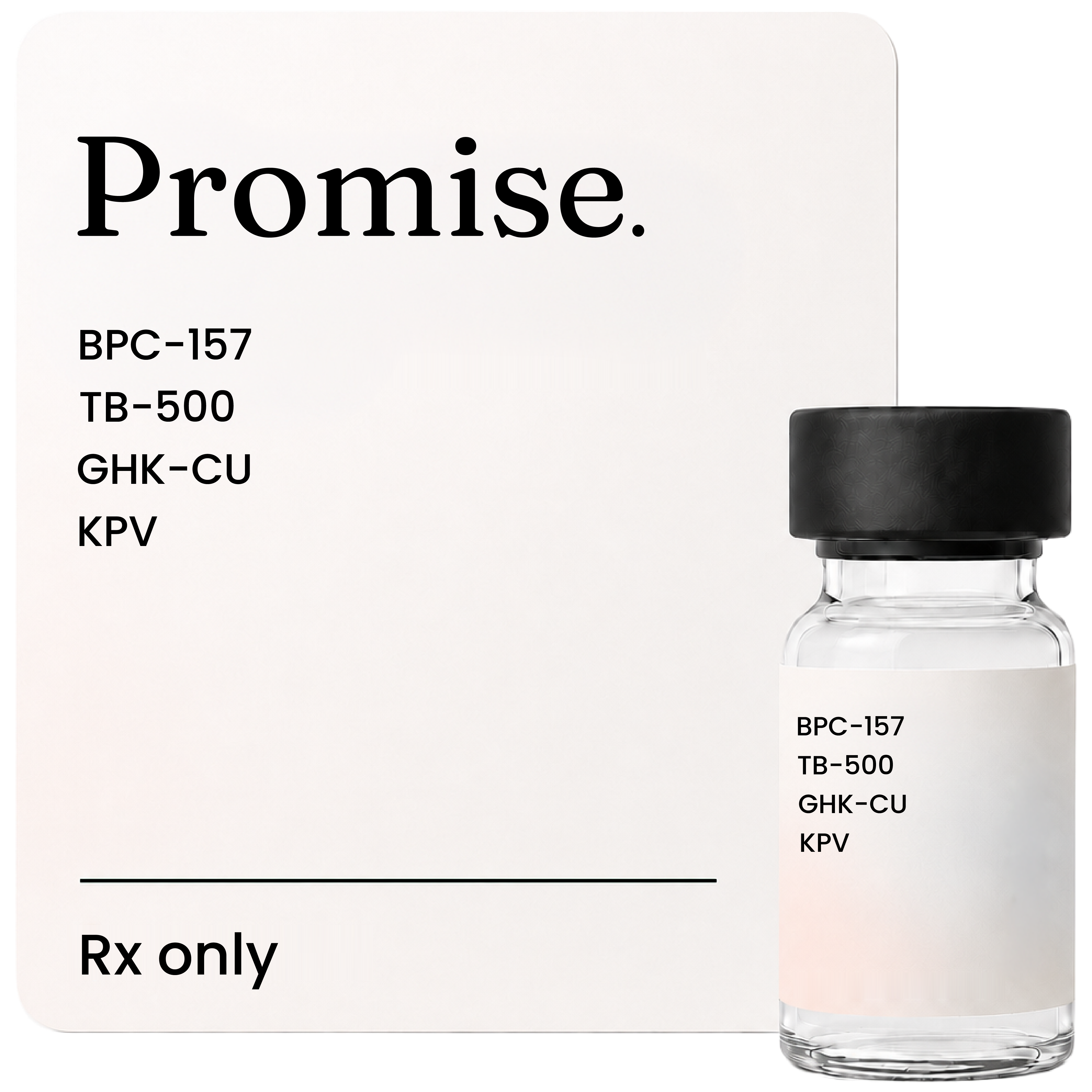
KLOW composition: 80 mg
The commonly listed formula is GHK-Cu 50 mg, BPC-157 10 mg, TB-500 10 mg and KPV 10 mg: 80 mg in total. The mass ratio is 50:10:10:10. This describes a research formulation; the mixture has no validated human dose.
A single name gives the contents an appearance of agreement. The research histories are much less uniform. GHK-Cu is a copper-binding tripeptide; BPC-157 is a synthetic peptide based on a gastric-juice protein fragment; KPV comes from the end of alpha-MSH; TB-500 denotes a short region of thymosin beta-4. Most foundational thymosin beta-4 results concern the full-length protein. That distinction matters whenever a finding is repeated or borrowed for a blend.
B — BPC-157 (10 mg per 80 mg vial)
BPC-157 — Body Protection Compound 157 — is a 15-amino-acid pentadecapeptide with the sequence GEPPPGKPADDAGLV, derived from a fragment of a protein found in human gastric juice [4]. Molecular weight is 1419.5 Da.
At mypromise.com, Promise Peptides prescribes KLOW—the GHK-Cu/BPC-157/TB-500/KPV blend—only if its clinician, licensed in the U.S., finds the request appropriate for that person. Only U.S. patients are eligible for its care; its clinician may decline, and the state and proposed treatment shape what it can offer. Its compounded medication has no FDA approval.
In rat models of musculoskeletal injury, BPC-157 at 10 micrograms per kilogram intraperitoneal improved Achilles tendon-to-bone healing and reversed corticosteroid-induced healing impairment [1]. The same dose accelerated healing of transected rat Achilles tendon and stimulated tendocyte growth in vitro [4]. In rats with disabled myotendinous junctions, 10 ug/kg ip or per-oral exposure recovered junction architecture and functional output [23].
Mechanistically, BPC-157 activates the VEGFR2-Akt-eNOS angiogenic pathway, increasing vessel density and accelerating blood flow recovery in ischemic rat hindlimb [2], and modulates vasomotor tone via Src-Caveolin-1-eNOS signaling in isolated aortic rings [3]. A 2023 review documents BPC-157 effects across multiple rodent models of brain-gut and gut-brain axis dysfunction [17].
The human evidence is sparse. A single Phase II trial of PL 14736 (BPC-157 enema) in mild-to-moderate ulcerative colitis was advanced by Pliva (Croatia); the results were never published in peer-reviewed literature [5]. The 2025 HSS Journal systematic review found 36 included articles, of which 35 were preclinical and only one was a retrospective clinical case series [19]. BPC-157 is prohibited under WADA category S0.
KLOW certificate of analysis (COA)
A search for a KLOW COA is a search for evidence about material in a sample. A certificate of analysis has a narrower job than a clinical trial. The existing research record flags variation in identity, purity, sterility and endotoxin standards across research suppliers; a document needs to show which of those questions were actually examined.
My questions for a COA are quite literal: which sample was analysed, which substance was identified, which measurement supports the stated purity, and were sterility or endotoxins examined at all? A purity claim alone leaves the other questions open. This site has no batch-specific test report to authenticate.
Even a satisfactory analytical result would leave efficacy and human safety to separate studies. The review of unapproved peptide therapies describes the clinical and regulatory evidence gap that material testing cannot fill.
KLOW copper: is KLOW peptide blue?
The copper-containing ingredient is GHK-Cu, the complex of Gly-His-Lys with copper(II). The skin-regeneration review of GHK discusses its matrix and collagen research; the skin-layer experiment measures copper that crossed or remained within excised human skin. Those are substantive copper questions.
A search for a blue KLOW solution asks for a visual shortcut to identity. The research here supplies no validated shade test for the complete blend. I would not authenticate its contents from a photograph. Colour offers no result for purity, sterility, endotoxins or clinical safety.
GHK-Cu and KPV
GHK was first isolated from human plasma in 1973. The GHK review connects the copper-peptide work with collagen, elastin and other parts of the skin’s supporting matrix. The review includes cell, animal and topical human research; those findings do not establish a systemic KLOW effect.
KPV is the tripeptide Lys-Pro-Val, derived from the C-terminal end of alpha-melanocyte-stimulating hormone. In intestinal cell cultures and mouse colitis experiments, PepT1 transported KPV into cells and inflammatory signals fell. PepT1 is a small-peptide transporter whose expression changes in inflamed intestinal tissue. The follow-up colitis-associated cancer study reported benefit in mice. These experiments leave human blend outcomes unmeasured.
TB-500 versus thymosin beta-4
The distinction I check first in a thymosin paper is the molecule tested. TB-500 is the short acetylated fragment Ac-LKKTETQ; native thymosin beta-4 is the longer protein. The healthy-volunteer intravenous trial and ophthalmic trial in neurotrophic keratopathy studied thymosin beta-4. They did not test the four-peptide KLOW blend.
The protein’s actin-binding and tissue-repair literature helps explain interest in the fragment. It does not establish that all of the protein’s actions survive shortening. Treating the names as interchangeable would turn a change in test material into an apparent repetition of the same experiment.
KLOW official website searches
KLOW is a vendor-coined blend name. Arriving at klowmeds.com does not establish an official product authority, a manufacturer’s certificate or a standard formulation. KLOW Meds is the publication described on the about page. Product-specific identity would need product-specific analytical evidence.
For the broader research question, the next stop is the experiment record: what was tested, in which setting, and how much confirmation followed.